Browse Collection

Year Created

2025

Year Acquired

2026

Surfaces

Paper

Medium

Inkjet print

Art Forms

Photograph

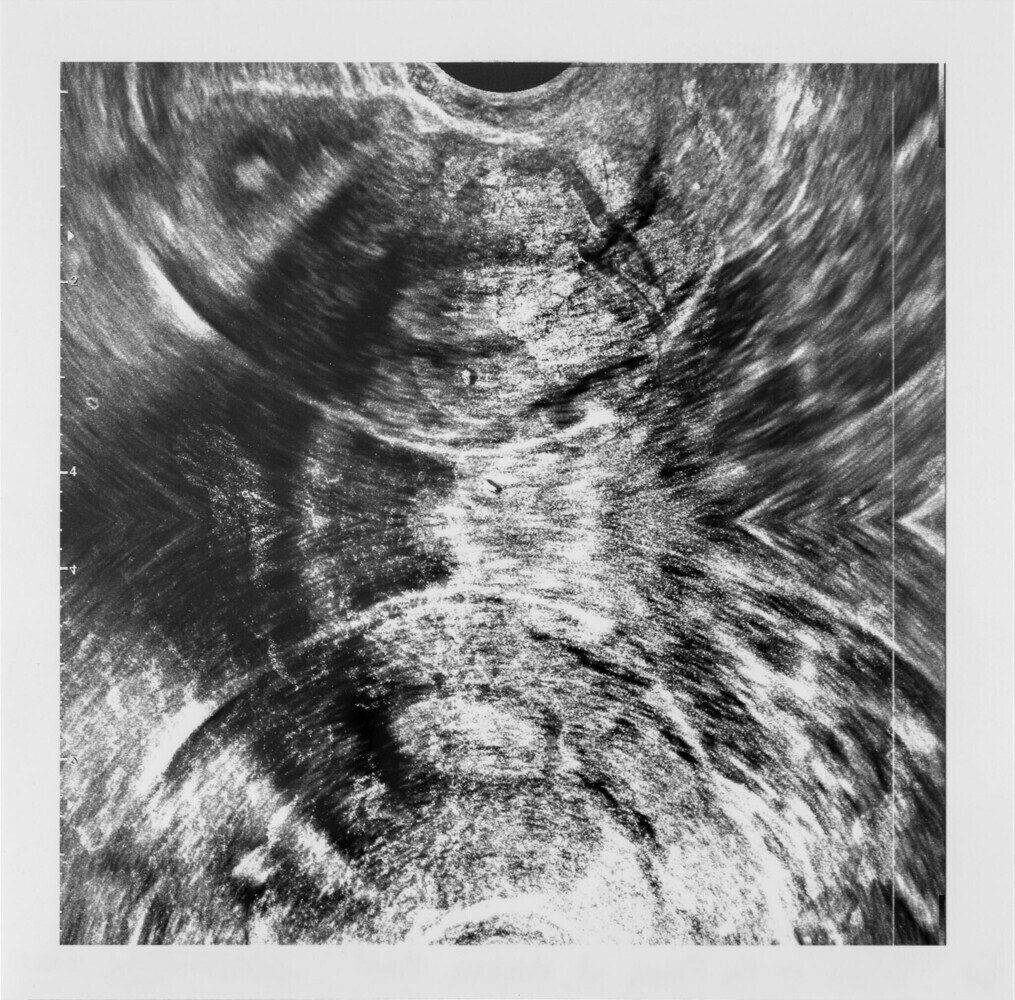
Étude corporelle No. 1: Polyps in the Flank of Volcanic Maat

by: Amanda Dawn Christie


Ideas for this project began germinating more than twenty years ago, when the artist was undergoing pelvic floor biofeedback therapy and confronted the immense gaps in medical research concerning female anatomy.


Two decades later, after discovering a tumour in her left breast, she noticed a striking similarity between the ultrasound images of her breast and radar images of the surface of planet Venus. Christie began comparing her other medical images (ultrasound, MRI, and X‑rays) with additional astronomical images—radio telescope data from the Arecibo Observatory in Puerto Rico and radar images from the Magellan spacecraft, which orbited Venus from 1990 to 1994. She observed that once identifying text was removed, it was sometimes difficult to distinguish which images came from inside her body and which came from outer space. This resonance between the cosmic and the internal, the macro and the micro, continued to call to her.


Études corporelles is a series of studies that merges astronomical images of celestial bodies with medical images of her internal organs. Research themes explored in this work include image‑making through sound waves and radio waves—via ultrasound and radar—as well as the electromagnetic similarities shared by celestial bodies and human bodies.
Small amanda Amanda Dawn Christie
Amanda Dawn Christie is an interdisciplinary new media artist currently living and working in Mi’kma’ki (Lutes Mountain, NB), where she developed a profound appreciation for the interplay between technology and nature. She makes films, photographs, drawings, installations, performances, and transmission artworks that capture the haunting beauty of disappearing technologies and the landscapes they leave behind.  

As a former contemporary dancer, many of her works involve reframing and reclaiming value for technological systems as well as human bodily systems that are different, disabled, breaking down, and/or otherwise deemed unworthy of maintenance by dominant cultures. After several years creating work with space science, she is now extending her practice to include medical technologies as way to draw parallels between the cosmos and the viscera, between electromagnetic waves and electrochemical transmissions.   

Christie’s work has been presented by various galleries, museums, festivals, and broadcasters around the world, including the National Arts Centre, the Canadian Film Institute, the Rotterdam Film Festival, the San Francisco Cinematheque, the Millenium Film Workshop in New York, Cannes Film Festival, Radio Web MACBA of the Museum of Contemporary Art Barcelona, and the BBC, among many others.   

Her interdisciplinary practice extends to audiences outside of contemporary art circles, and has been profiled by international electronic engineering, shortwave, and hacking publications. Critical and acclaimed analyses of Christie’s work have been published in scholarly books, catalogues, and journals. Her films are distributed by the CFMDC, V-Tape, and Lightcone and her works can be found in various private and public art collections.